§ 05Price
One plan, no surprises.
€12/ month
120 answers a month, every result checked by the CAS. Answers that fail or that you cancel do not count.
Launch price, to be confirmed.
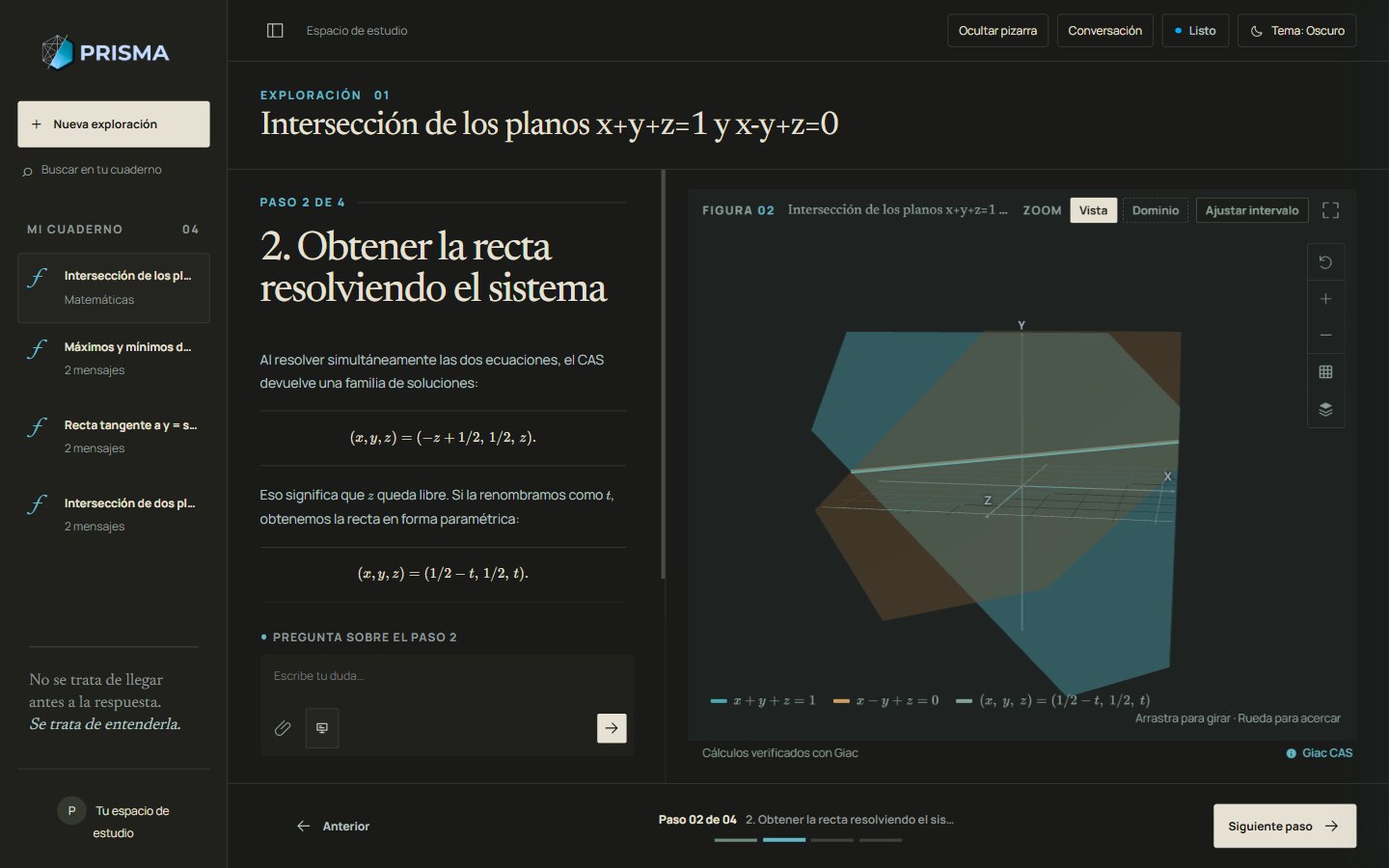
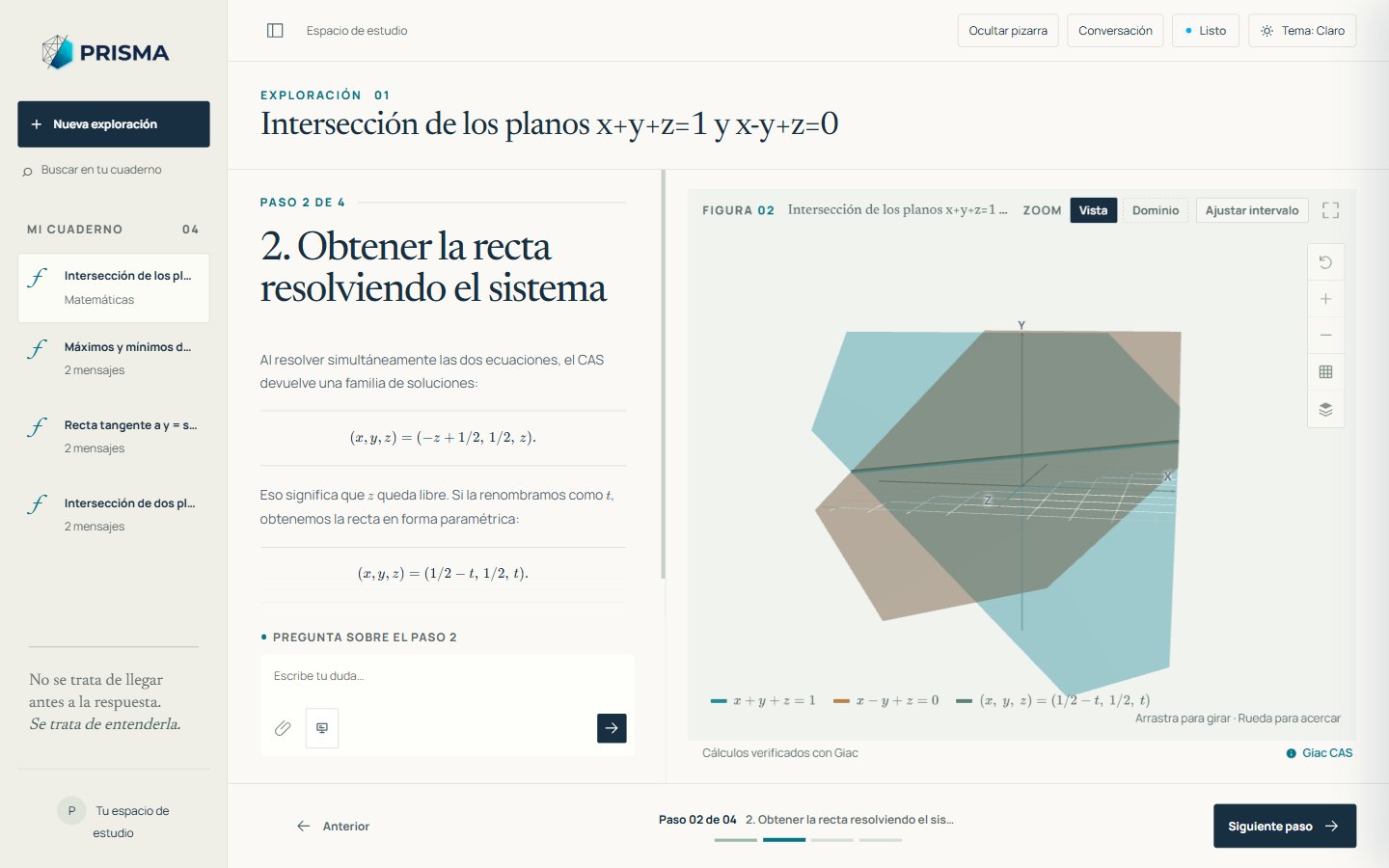
Fig. 01 · x + y + z = 1 ∩ x − y + z = 0
Step-by-step maths lessons on a 2D and 3D board, every result checked by a computer algebra system.
§ 01A lesson, step by step
This is a real lesson, shortened: a student's question about a tangent line. Scroll down and watch the board build with each step.
“What is the tangent to y = sin x at x = π/4?”
Step 1 of 4
Not just any line: it has to touch the curve at x = π/4. For the full point we also need its height: sin(π/4) = √2/2.
CASsubst(sin(x), x=pi/4)√2/2✓ checked
Step 2 of 4
The tangent has the same steepness as the curve at P. Since f′(x) = cos x, the slope is cos(π/4) = √2/2. Common mistake: using sin(π/4), which is the height, not the steepness.
CASsubst(diff(sin(x),x), x=pi/4)√2/2✓ checked
Step 3 of 4
With the point and the slope, the point-slope form gives the line: y = √2/2 + √2/2 · (x − π/4).
CASy = subst(sin(x),x=pi/4) + subst(diff(sin(x),x),x=pi/4)·(x−pi/4)√2/2 + √2/2·(x − π/4)✓ checked
Step 4 of 4
The line touches the curve at P and shares its slope right there. It does not match sin x everywhere: it approximates it near the point. That is the idea of the derivative.
Steps shortened from a lesson PrismaMath generated on 26 September 2026 (in Spanish).
Every lesson works like this: explained step by step, drawn and checked.
§ 02The difference
A computer algebra system (CAS) does the maths. Every result in a lesson goes through it on the server. If something cannot be checked, the answer is marked unverified or withheld; it is never presented as verified.
subst(diff(sin(x),x), x=pi/4)§ 03The study room
You move through the steps with “Next” and “Previous”, rotate and zoom the figure, and ask about the step you are on. Your lessons stay in your notebook. Light and dark mode, on your phone too.
§ 04Topics
Some topics we have already tried with real questions:
Useful for calculus and linear algebra courses and exam preparation.
§ 05Price
€12/ month
120 answers a month, every result checked by the CAS. Answers that fail or that you cancel do not count.
Launch price, to be confirmed.
§ 06For teachers and schools
PrismaMath works with Moodle through LTI 1.3: a teacher adds a topic to their course and students open it with a starter question. We do not ask for student names or emails, and it is for formative use: it does not grade.
How it works in a school →We are opening access gradually. Leave your email and we will write to you.
Request access